Have you ever been assigned to read a book for class and enjoyed it so much you almost feel like you're cheating your professor? That is precisely how I feel about Maryse Condé's novel, Heremakhonon. Admittedly, my initial reaction to this particular text was that of frustration. The novel, originally written in French, was translated into English by Richard Philcox. Certainly, as with any translated text, much is lost through the process of translation. Also, Condé is well versed in history, English and philosophy, continually referencing Aphra Behn and Frantz Fanon.
What I really enjoy about this novel is its protagonist, Veronica Mercier, a woman from the Caribbean who returns to West Africa on a quest to discover and establish her identity. An unreliable narrator, Veronica is constantly misreading situations, misinterpreting interactions of other characters, and is misguided by her own poor judgment. But what is admirable about her is that she speaks through a sort of interior monologue, a stream of consciousness, if you will. What's stunning is that the reader cannot tell if she is talking or thinking, meshing the complexity of her unabridged, innermost thoughts with revealing what she deems appropriate to say out loud. There are no quotations used to indicate a response, leaving the reader with the problem of having to figure out which speech is dialogue and which speech is interior monologue.
I'm finding myself constantly enlightened by the social and political aspects Condé touches on in the text. More importantly, Veronica moves through the novel thinking the man she is sleeping with will give her the sense of identity she has been seeking. She falsely imagines that she is a free woman, to express herself sexually with the men she chooses--the problem however, is that all the men she mentions having slept with or is currently sleeping with--have instead, chosen her.
In class today, my professor mentioned the tradition of arranged marriages. Although it's not the most common form of partnering these days, many of us consider ourselves "free" in choosing our significant others, our sexual partners, and ultimately, the person we will marry. My professor mentioned Veronica's sexual relationship with Ibrahima as a kind of "trading up," because ideally, he is the West African's equivalent of a prominent white man.
She then brought to light the idea that we (most of us, anyway) sleep with people whom we think would maintain a sort of class consolidation, appropriately perpetuating the class we belong to, or with an aim to attain a higher status level, in conjunction with society's norms. On some level, I admit that yes, of course I choose who I date, who I sleep with, etc, but how much of what goes in to that decision making does that notion of class consolidation apply to? So, naturally, I begin to wonder about this concept and take into consideration men I've dated--and realize in the puzzled faces of students around me, that I am not the only one thinking about this. But that's another blog entry in itself...
I envy Veronica in the sense that she is so misguided yet is so clear in few, but certain significant observations. For example, on page 47, her interior monologue reads:
"In my opinion, it's not the first time you make love, but the second, that is the most delicate. You are no longer strangers, eager to get to know each other. Not yet intimate enough to stop at nothing."
It almost seems impossible that, for a character who stands in the way of her own answers, she is able to strip away the bullshit and get right to what matters, appealing to readers on levels previously unmatched. I really like the idea of the delicacy of the second time, it's true yet who, before reading this, already knew that? I mean, of course the first time with any new person is going to be tricky and awkward and sometimes pleasurable, but really, who stops to think about the second time? With it, there's still a fraction of the unknown that is attached, but it's nothing like the first time, going in without any prior knowledge. You're both hopefully at ease this time, not focusing on the pressures that come with the first time you have sex. There's no hesitation, no holding back, and simply no reservations. You "get to know" the other person through physical exploration, as if by kissing someone passionately unlocks their secrets, and by firmly framing their face in your hands as you do so, uncovers truths about the center of their very being. At the same time, the second sexual encounter is nothing like the tenth time you sleep with someone, when you already know full well what they enjoy, their preferences and quirks have been memorized time and time again. You are "not yet intimate to stop at nothing," she claims, and damn, isn't she right?
I could go on, but hell week has only just begun and I've spent nearly an hour blogging about this instead of being more productive. The bottom line is that this novel is certainly worth reading although I highly recommend doing some research and finding some secondary materials to better assist you in your understanding of the plot. There are a lot of literary and philosophical references, most of which were lost on me until I did some further research. I think Veronica, in not knowing herself, has the innate ability to reveal to ourselves a portion of our own identity, through her own exploratory experiences.
Showing posts with label Writing. Show all posts
Showing posts with label Writing. Show all posts
Tuesday, October 21, 2008


Wednesday, October 8, 2008
The Namesake
A year ago I read Jhumpa Lahiri's collection of short stories, The Interpreter of Maladies. These nine stories revolved around Indian-American families whose lives changed upon emigrating from India and settling into America. Lahiri's first novel, The Namesake, was adapted into a film of the same name. I have not read the book version but have recently watched the movie starring Kal Penn, Tabu, Irfan Khan and Jacinda Barrett.
Before finally watching this movie on Monday, I had heard so many rave reviews from friends, mostly generic "It's just such a good movie," type-comments. Since I had already read and enjoyed Lahiri 's writing, I knew it was worthwhile. So I figured maybe I'd watch the movie before I read the book (I like to read the book first) simply because there is just no time for me to read it now.
About ten minutes into the movie, Ashima recites William Wordsworth's "I Wandered Lonely As A Cloud," to Ashoke and his family at a rather informal arranged marriage meeting. And I think it was the way she recited it, the hesitating yet certain way the words came out of her mouth just moved me. You believe in her sentiment, she does not recite the poem to impress the family, you know that she too was moved the first time she read it and that comes off quite clearly in the way she shares the poem. Fast-forward: they get married and move to America and have two children, Gogol (Kal Penn), and Sonia (Sahira Nair).
Before finally watching this movie on Monday, I had heard so many rave reviews from friends, mostly generic "It's just such a good movie," type-comments. Since I had already read and enjoyed Lahiri 's writing, I knew it was worthwhile. So I figured maybe I'd watch the movie before I read the book (I like to read the book first) simply because there is just no time for me to read it now.
About ten minutes into the movie, Ashima recites William Wordsworth's "I Wandered Lonely As A Cloud," to Ashoke and his family at a rather informal arranged marriage meeting. And I think it was the way she recited it, the hesitating yet certain way the words came out of her mouth just moved me. You believe in her sentiment, she does not recite the poem to impress the family, you know that she too was moved the first time she read it and that comes off quite clearly in the way she shares the poem. Fast-forward: they get married and move to America and have two children, Gogol (Kal Penn), and Sonia (Sahira Nair).
I could write you an essay on Wordsworth, but I won't. "I Wandered Lonely As A Cloud," is in short, a poem that praises the power of memory whose significance still carries affective power in the present day.
I Wandered Lonely As A Cloud by William Wordsworth
I wandered lonely as a cloud
That floats on high o'er vales and hills,
When all at once I saw a crowd,
A host of golden daffodils;
Beside the lake, beneath the trees,
Fluttering and dancing in the breeze.
Continuous as the stars
that shine and twinkle on the Milky Way,
They stretched in never-ending line
along the margin of a bay:
Ten thousand saw I at a glance,
tossing their heads in sprightly dance.
The waves beside them danced; but they
Out-did the sparkling waves in glee:
A poet could not but be gay,
in such a jocund company:
I gazed - and gazed - but little thought
what wealth the show to me had brought:
For oft, when on my couch I lie
In vacant or in pensive mood,
They flash upon that inward eye
Which is the bliss of solitude;
And then my heart with pleasure fills,
And dances with the daffodils.
That floats on high o'er vales and hills,
When all at once I saw a crowd,
A host of golden daffodils;
Beside the lake, beneath the trees,
Fluttering and dancing in the breeze.
Continuous as the stars
that shine and twinkle on the Milky Way,
They stretched in never-ending line
along the margin of a bay:
Ten thousand saw I at a glance,
tossing their heads in sprightly dance.
The waves beside them danced; but they
Out-did the sparkling waves in glee:
A poet could not but be gay,
in such a jocund company:
I gazed - and gazed - but little thought
what wealth the show to me had brought:
For oft, when on my couch I lie
In vacant or in pensive mood,
They flash upon that inward eye
Which is the bliss of solitude;
And then my heart with pleasure fills,
And dances with the daffodils.
The first three stanzas set up the experience Wordsworth had while walking with his sister, Dorothy, as they came upon a long row of daffodils at the edge of a lake. (Although, if you want to be technical, Wordsworth added the second stanza eight years after it was originally published.) But in the fourth and final stanza of the poem, we learn that Wordsworth is still stuck in the original moment of the first experience. And it doesn't hold him back, "And then my heart with pleasure fills, / And dances with the daffodils" (23-24), it instead gives him solace. Wordsworth constantly invokes these "spots of time" throughout his poetry, and they can especially be found in one of his most famous poems, "Lines Composed a Few Miles Above Tintern Abbey."
What I love about The Namesake, the movie version at least, is that you don't know whose story is being told. The movie is composed of sections that focus on different members of the Ganguli family. We feel the alienation, resentment, and the misunderstanding between all of them. Like Wordsworth, Gogol's parents, Ashoke and Ashima adjust to America but still remember and yearn for their life in India. Their own reflective spots of time help them through the difficulty of leaving behind family and old traditions to forge an entirely new kind of life for their children. The movie constantly flashes back to various segments of their lives back home. And it's through this method of superimposing their memories to their present day lives that ultimately provides them with their own sense of solace.
The very last scene of the movie almost killed me. It's another flashback of Ashima, Ashoke and young Gogol at the waters edge. The scene was shown earlier in the movie but only from Ashima's perspective.
Ashoke and Gogol walk to the edge of the rocks, surrounded by splashing waves. Ashoke is holding on to Gogol's hand as they come to the end of the path. He mentions to Gogol that they had come all this way only to forget to bring the camera and take a picture. He asks Gogol if he'll remember this moment, remember that they came to a place where they could no longer go on, and Gogol naively replies, "How long do I have to remember it for?" Oh my, there's just so much at work in this scene! It's beautiful and I think if the filmmaker can capture and invoke Wordsworth as Lahiri has so stunningly well, then I may need to pick up that book sooner than I had realized.
This movie possesses an abundance of themes and I cannot touch on all of them, but I do honestly recommend you watch it. And I want someone to talk about it with, so do yourself and myself a favor!
What I love about The Namesake, the movie version at least, is that you don't know whose story is being told. The movie is composed of sections that focus on different members of the Ganguli family. We feel the alienation, resentment, and the misunderstanding between all of them. Like Wordsworth, Gogol's parents, Ashoke and Ashima adjust to America but still remember and yearn for their life in India. Their own reflective spots of time help them through the difficulty of leaving behind family and old traditions to forge an entirely new kind of life for their children. The movie constantly flashes back to various segments of their lives back home. And it's through this method of superimposing their memories to their present day lives that ultimately provides them with their own sense of solace.
The very last scene of the movie almost killed me. It's another flashback of Ashima, Ashoke and young Gogol at the waters edge. The scene was shown earlier in the movie but only from Ashima's perspective.
Ashoke and Gogol walk to the edge of the rocks, surrounded by splashing waves. Ashoke is holding on to Gogol's hand as they come to the end of the path. He mentions to Gogol that they had come all this way only to forget to bring the camera and take a picture. He asks Gogol if he'll remember this moment, remember that they came to a place where they could no longer go on, and Gogol naively replies, "How long do I have to remember it for?" Oh my, there's just so much at work in this scene! It's beautiful and I think if the filmmaker can capture and invoke Wordsworth as Lahiri has so stunningly well, then I may need to pick up that book sooner than I had realized.
This movie possesses an abundance of themes and I cannot touch on all of them, but I do honestly recommend you watch it. And I want someone to talk about it with, so do yourself and myself a favor!
Thursday, October 2, 2008
Moleskine Madness
On Wednesdays I have lunch with my friend Alice. Yesterday, we sat in the quad talking about anything and everything. She's a fiction writer, so naturally (as we always do) we began to talk about our writing endeavors.
She told me how her fiction writing professor suggested she befriend everyone in her class since in the future, they will be the ones to write on the back of her book when she gets published. How true is that? She then made me promise I'd write on the back of her future book. I told her it'd be an honor.
I began to tell her about a tree I saw while waiting for my train at my Lake Forest station. This tree had luscious, green leaves save for the very top. The top (and only the top) of this tree was stained plum. I stared at it, mesmerized, what a sight. I had to write down my thoughts, needed to write down this image.
In a rush to get out the door, I had left my notebook in my bedroom. Frantically searching for anything other than a receipt to write on, I resorted to having to jot down these lines onto the front page of my Tribune. I told her this and she laughed in response. She then told me that she used to write in the margins of her assignment notebook, or anything she could get her hands on, that is of course, until she received her very own Moleskine.
So for those of you that don't know me, I tend to get paranoid about the randomest things. While talking to Alice, I knew I needed to buy a Moleskine as soon as possible. The first thing that crossed my mind was, what do you write on the first page? And so I asked her, and she replied, "Anything you want, just pick a random page." Wow. That may have been the simplest, most truthful answer possible. And so, with that in mind, (and I know she'll read this), on the second page of my Moleskine (my first page is still blank), I wrote exactly that, "Pick a random page."
After our lunch, I bought my very own Moleskine. I know what you must be thinking...what kind of writer are you not having a Moleskine?! Crazy, I know. It was just one of those things I never got around to buying. I've always wanted one but deep down I think I was always waiting for someone to buy one for me. No, not because I couldn't afford it, but because it would have sentimental value, the ultimate gift. Honestly, what better gift could there be (for a writer) than place in which to store thoughts and inspiration? Most of you might argue that your memory would be gift enough but let me tell you, us writers have a lot of shit going on all at one time up there, we operate on a level of consciousness that is simply chaotic. Parts of stories, unfinished poems, images, memories--all begin to mesh together and when something new pops up we need to write it down or else count on it being forgotten forever.
I'm so glad to finally have one now but I am seriously still traumatized for not having gotten one sooner. I began to think of all the things I've learned, namely literary devices, tropes, my favorite poems, passages, quotes, etc...from different literature classes that weren't properly recorded. Sigh.
So do you remember that guy in my British Literature class? Well, I had my Moleskine out on top of my notebook on our table today and he walked in and admired my Moleskine. He took his out and noted that they were exactly the same, "I hope we don't get them confused," he chided. I laughed, not realizing they were identical until he pointed it out. I mentioned that his Moleskine had lined pages and mine did not, he then assessed that I was "a free spirit." All throughout class we took turns writing in our Moleskines. It was then that I decided that I did not want to know (and did not need to know) what it is he writes in there.
On my way to Sociology today, I ran into my friend, Beatriz. This girl is unbelievably talented, she has a poetry reading later this month at Woman Made Gallery! We were talking before class and I mentioned my excitement about my Moleksine and she practically shouted with enthusiasm. (I'm pretty sure only us geeky-writer types jump for joy at the mere mention of a Moleskine.) "I just bought one last week!" she told me. I cannot begin to tell you how loud we had gotten at this point. Unfortunately, we ran out of time but set a lunch date to talk poetry and such next week. Guess who is excited? So excited in fact, I might just write about said excitement in my Moleskine.
P.S. I know some friends who will be getting Moleskines as Christmas gifts.
My Favorite Moleskin Blurbs thus far: (Just a little sampling of course since I can't let you read all my thoughts, now can I?)
She told me how her fiction writing professor suggested she befriend everyone in her class since in the future, they will be the ones to write on the back of her book when she gets published. How true is that? She then made me promise I'd write on the back of her future book. I told her it'd be an honor.
I began to tell her about a tree I saw while waiting for my train at my Lake Forest station. This tree had luscious, green leaves save for the very top. The top (and only the top) of this tree was stained plum. I stared at it, mesmerized, what a sight. I had to write down my thoughts, needed to write down this image.
In a rush to get out the door, I had left my notebook in my bedroom. Frantically searching for anything other than a receipt to write on, I resorted to having to jot down these lines onto the front page of my Tribune. I told her this and she laughed in response. She then told me that she used to write in the margins of her assignment notebook, or anything she could get her hands on, that is of course, until she received her very own Moleskine.
So for those of you that don't know me, I tend to get paranoid about the randomest things. While talking to Alice, I knew I needed to buy a Moleskine as soon as possible. The first thing that crossed my mind was, what do you write on the first page? And so I asked her, and she replied, "Anything you want, just pick a random page." Wow. That may have been the simplest, most truthful answer possible. And so, with that in mind, (and I know she'll read this), on the second page of my Moleskine (my first page is still blank), I wrote exactly that, "Pick a random page."
After our lunch, I bought my very own Moleskine. I know what you must be thinking...what kind of writer are you not having a Moleskine?! Crazy, I know. It was just one of those things I never got around to buying. I've always wanted one but deep down I think I was always waiting for someone to buy one for me. No, not because I couldn't afford it, but because it would have sentimental value, the ultimate gift. Honestly, what better gift could there be (for a writer) than place in which to store thoughts and inspiration? Most of you might argue that your memory would be gift enough but let me tell you, us writers have a lot of shit going on all at one time up there, we operate on a level of consciousness that is simply chaotic. Parts of stories, unfinished poems, images, memories--all begin to mesh together and when something new pops up we need to write it down or else count on it being forgotten forever.
I'm so glad to finally have one now but I am seriously still traumatized for not having gotten one sooner. I began to think of all the things I've learned, namely literary devices, tropes, my favorite poems, passages, quotes, etc...from different literature classes that weren't properly recorded. Sigh.
So do you remember that guy in my British Literature class? Well, I had my Moleskine out on top of my notebook on our table today and he walked in and admired my Moleskine. He took his out and noted that they were exactly the same, "I hope we don't get them confused," he chided. I laughed, not realizing they were identical until he pointed it out. I mentioned that his Moleskine had lined pages and mine did not, he then assessed that I was "a free spirit." All throughout class we took turns writing in our Moleskines. It was then that I decided that I did not want to know (and did not need to know) what it is he writes in there.
On my way to Sociology today, I ran into my friend, Beatriz. This girl is unbelievably talented, she has a poetry reading later this month at Woman Made Gallery! We were talking before class and I mentioned my excitement about my Moleksine and she practically shouted with enthusiasm. (I'm pretty sure only us geeky-writer types jump for joy at the mere mention of a Moleskine.) "I just bought one last week!" she told me. I cannot begin to tell you how loud we had gotten at this point. Unfortunately, we ran out of time but set a lunch date to talk poetry and such next week. Guess who is excited? So excited in fact, I might just write about said excitement in my Moleskine.
P.S. I know some friends who will be getting Moleskines as Christmas gifts.
My Favorite Moleskin Blurbs thus far: (Just a little sampling of course since I can't let you read all my thoughts, now can I?)
- "That banana isn't allowed in here."
- ass mouth otter ass mouth chalk board
- "How can you write without your memory?"
- en*jamb*ment
- Man is nothing else except for what he makes of himself.
Sunday, September 28, 2008
Daffy Duck in Hollywood
Donald Hall once said, “There is nothing like hearing the poet’s voice. The entryway to poetry is the beauty of its sound. Sound persuades us of its authenticity and prepares us to receive the subtlety and power of its emotion."
Hearing a poem and reading a poem are two entirely different experiences. In my final workshop class last fall, my professor insisted that we read our poem aloud first and then someone else in the class would read it after. I'm not sure I liked his approach, how would someone else know how to read my poem, know the proper pauses at which to linger, or know which words needed to be emphasized? Needless to say, I didn't enjoy listening to my own words read aloud, back to me-- it was as if someone was inside my head, retelling myself of my thoughts already thought. It's not until you hear your own thoughts read back to you that begin to hear yourself, sometimes even for the first time. Every writer has a voice, a style, a rhythm--and I began to hear my own.
I was talking to my friend, Griffin, who has a tendency to insert asides into our instant messaging conversations. Every now and then he'd narrate himself, his actions or even his thoughts. I find myself entertained by his random insertions of these asides and told him that I've always wanted to write a poem based solely on asides. Although when I think of an aside I immediately think of a soliloquy and just would not know where to begin writing. So I began to research writing in the style of the dramatic monologue, which focuses on just the writer's thoughts and perspective with no influence of any outside voice, so there is no dialogue. The writer's speech or commentary is written with the idea of an "implied" audience.
I looked for an example of such a poem and read several, although I enjoyed John Ashbery's "Daffy Duck in Hollywood," the most. It's long and at first seems like just a constant barrage of images and thoughts that are scattered and unorganized. But there is something in the chaos of his speech that is inexplicably captivating and relatable. My favorite lines (54-57) of this poem make me feel like I could have written them myself, Ashbery's universality here is so appealing:
I have
Only my intermittent life in your thoughts to live
Which is like thinking in another language. Everything
Depends on whether somebody reminds you of me.
I admit that I'm not yet prepared to write a poem of that caliber, with such an honest voice as Ashbery's. But writing a dramatic monologue is certainly on my to-do list. The idea of voices in poetry reminded me of a collaboration poem I wrote last year with my best friend, fellow poet, Francesca Pestano. Originally an assignment in class, we decided to write this collaboration poem as prose, something we both struggled with. In this poem I hear my voice, I hear her voice and in certain instances--because our words in English didn't suffice, I hear the lines of tagalog. We felt that writing in our native language worked for this poem, on levels that we couldn't make English work. Many of our peers, (writers and friends) jokingly say that we're the same person, with few but important differences. When we read this poem in class together, we divided the lines intentionally and it sounded like a well rehearsed spoken word segment. After we read the poem the first comment we received was that our voices were indistinguishable. Our classmates, who had been reading our poetry for three months, could not tell who had written which lines--and we were speechless with disbelief. This is a poem we've been meaning to edit for quite some time now, but I'll share it with you as it is. It's a melding of our own experiences, of both happy and painful memories from past relationships. I took a picture of the draft that I wrote by hand and xerox copied for class, we felt that hand-writing it made it more personal, almost like a journal or diary entry.
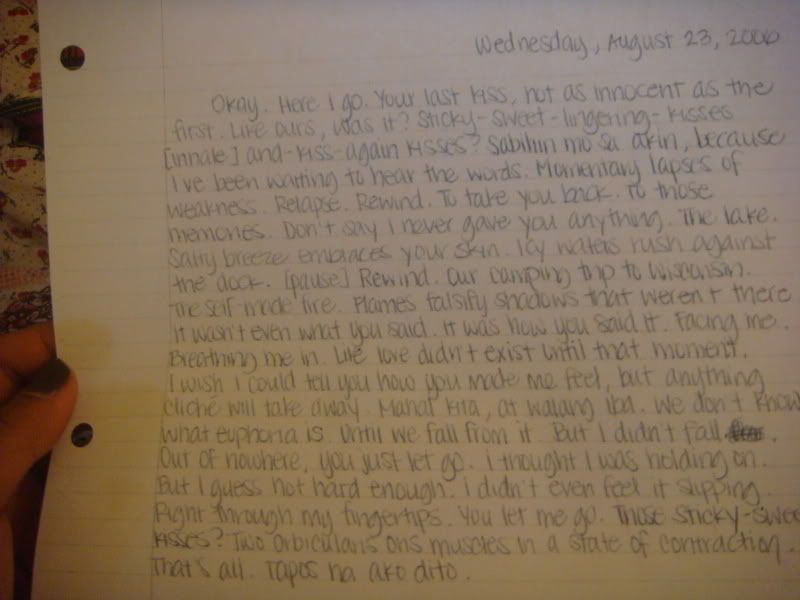
I know some of you can't honestly read that, so I'll type it out for you. Your thoughts are always welcome.
Wednesday, August 23, 2006
Okay. Here I go. Your last kiss, not as innocent as the first. Like ours, was it? Sticky-sweet-lingering-kisses [inhale] and-kiss-again-kisses? Sabihin mo sa akin, because I've been waiting to hear the words. Momentary lapses of weakness. Relapse. Rewind. To take you back. To those memories. Don't say I never gave you anything. The lake. Salty breeze embraces your skin. Icy waters rush against the dock. [pause] Rewind. Our camping trip to Wisconsin. The self-made fire. Flames falsify shadows that weren't there. It wasn't even what you said. It was how you said it. Facing me. Breathing me in. Like love didn't exist until that moment. I wish I could tell you how you made me feel, but anything cliche will take away. Mahal kita, at walang iba. We don't know what euphoria is until we fall from it. But I didn't fall. Out of nowhere, you just let go. I thought I was holding on. But I guess not hard enough. I didn't even feel it slipping. Right through my fingertips. You let me go. Those sticky-sweet-kisses? Two orbicularis oris muscles in a state of contraction. That's all. Tapos na ako dito.
Hearing a poem and reading a poem are two entirely different experiences. In my final workshop class last fall, my professor insisted that we read our poem aloud first and then someone else in the class would read it after. I'm not sure I liked his approach, how would someone else know how to read my poem, know the proper pauses at which to linger, or know which words needed to be emphasized? Needless to say, I didn't enjoy listening to my own words read aloud, back to me-- it was as if someone was inside my head, retelling myself of my thoughts already thought. It's not until you hear your own thoughts read back to you that begin to hear yourself, sometimes even for the first time. Every writer has a voice, a style, a rhythm--and I began to hear my own.
I was talking to my friend, Griffin, who has a tendency to insert asides into our instant messaging conversations. Every now and then he'd narrate himself, his actions or even his thoughts. I find myself entertained by his random insertions of these asides and told him that I've always wanted to write a poem based solely on asides. Although when I think of an aside I immediately think of a soliloquy and just would not know where to begin writing. So I began to research writing in the style of the dramatic monologue, which focuses on just the writer's thoughts and perspective with no influence of any outside voice, so there is no dialogue. The writer's speech or commentary is written with the idea of an "implied" audience.
I looked for an example of such a poem and read several, although I enjoyed John Ashbery's "Daffy Duck in Hollywood," the most. It's long and at first seems like just a constant barrage of images and thoughts that are scattered and unorganized. But there is something in the chaos of his speech that is inexplicably captivating and relatable. My favorite lines (54-57) of this poem make me feel like I could have written them myself, Ashbery's universality here is so appealing:
I have
Only my intermittent life in your thoughts to live
Which is like thinking in another language. Everything
Depends on whether somebody reminds you of me.
I admit that I'm not yet prepared to write a poem of that caliber, with such an honest voice as Ashbery's. But writing a dramatic monologue is certainly on my to-do list. The idea of voices in poetry reminded me of a collaboration poem I wrote last year with my best friend, fellow poet, Francesca Pestano. Originally an assignment in class, we decided to write this collaboration poem as prose, something we both struggled with. In this poem I hear my voice, I hear her voice and in certain instances--because our words in English didn't suffice, I hear the lines of tagalog. We felt that writing in our native language worked for this poem, on levels that we couldn't make English work. Many of our peers, (writers and friends) jokingly say that we're the same person, with few but important differences. When we read this poem in class together, we divided the lines intentionally and it sounded like a well rehearsed spoken word segment. After we read the poem the first comment we received was that our voices were indistinguishable. Our classmates, who had been reading our poetry for three months, could not tell who had written which lines--and we were speechless with disbelief. This is a poem we've been meaning to edit for quite some time now, but I'll share it with you as it is. It's a melding of our own experiences, of both happy and painful memories from past relationships. I took a picture of the draft that I wrote by hand and xerox copied for class, we felt that hand-writing it made it more personal, almost like a journal or diary entry.
I know some of you can't honestly read that, so I'll type it out for you. Your thoughts are always welcome.
Wednesday, August 23, 2006
Okay. Here I go. Your last kiss, not as innocent as the first. Like ours, was it? Sticky-sweet-lingering-kisses [inhale] and-kiss-again-kisses? Sabihin mo sa akin, because I've been waiting to hear the words. Momentary lapses of weakness. Relapse. Rewind. To take you back. To those memories. Don't say I never gave you anything. The lake. Salty breeze embraces your skin. Icy waters rush against the dock. [pause] Rewind. Our camping trip to Wisconsin. The self-made fire. Flames falsify shadows that weren't there. It wasn't even what you said. It was how you said it. Facing me. Breathing me in. Like love didn't exist until that moment. I wish I could tell you how you made me feel, but anything cliche will take away. Mahal kita, at walang iba. We don't know what euphoria is until we fall from it. But I didn't fall. Out of nowhere, you just let go. I thought I was holding on. But I guess not hard enough. I didn't even feel it slipping. Right through my fingertips. You let me go. Those sticky-sweet-kisses? Two orbicularis oris muscles in a state of contraction. That's all. Tapos na ako dito.
Monday, September 22, 2008
Untitled
People often ask me what the hardest part of writing a poem is. My poems almost always stem from a memory. An image, a sound, a fleeting thought even, provokes a sort of inspiration that ties past to present. A sensation familiar to something else, of someone else also inspires me. I then try to make sense of the blurred boundary of what was and what is. I manipulate my memories to rework it into something else, wondering what really happened. This attempt at manipulation allows me to compose the memory I wish I'd had, although that is sometimes simply unattainable. The hardest part of writing, for me, is the conception of a title. I know some writers that start poems with their title, unable to continue with the actual poem unless a title is chosen. I know others that write out the poem first and then choose a title. I also know some writers who write out the entire poem first and always select a significant line in the poem as their title. The title is the first impression made upon the reader. It sets the tone, alludes to its context, and begins the story about to be told. A title must be chosen carefully, so as not to discredit the poem. My titles are usually synonymous with the meaning of the poem in my eyes. It is rare that I write a poem and leave it untitled. In today's instance however, several titles came to mind when writing this poem, but nothing proved sufficient. I wrote this poem on the train today, heading home from class. I began writing as the train pulled out of Union Station and finished just before my Lake Forest stop, about 55 minutes altogether. It's also very rare that I share the very first draft of any poem, especially only hours after it's written. I know that a train ride might seem like a short amount of time to write a poem, but on occasions like these--when my need to write is urgent and spontaneous, I can produce work almost immediately. I'm leaving this poem untitled for the reasons already stated above. I suppose I'll leave it up to the readers to take it upon themselves to title it as they see fit, to take the poem as their own, to make sense of their own blurred boundaries.
Untitled
I woke a remembered montage
of days disrupted and recollected.
Disruptive more than
recollected.
My memories enjamb
my present. Paus-
ing intentionally on
my mind's scratched
surface, the needle plays--
1.
[sun stricken water
fights watched by
curious eyes through
green sheathed curtains.]
2.
[your footfalls in
the hall, you crawl
into bed beside me; seventeen
missed calls.]
the superimposition of
marred befores invade
my unhappened afters
uninvited.
the once soothing strokes
of the piano slow post
climax. the lyrics go
unheard. the omission of velvet
notes strain.
chapped lips purse
subversively, hushing the
rivulets of sweat
and sound.
the crescendo falls.
the needle searches.
the record spins. silent static.
Untitled
I woke a remembered montage
of days disrupted and recollected.
Disruptive more than
recollected.
My memories enjamb
my present. Paus-
ing intentionally on
my mind's scratched
surface, the needle plays--
1.
[sun stricken water
fights watched by
curious eyes through
green sheathed curtains.]
2.
[your footfalls in
the hall, you crawl
into bed beside me; seventeen
missed calls.]
the superimposition of
marred befores invade
my unhappened afters
uninvited.
the once soothing strokes
of the piano slow post
climax. the lyrics go
unheard. the omission of velvet
notes strain.
chapped lips purse
subversively, hushing the
rivulets of sweat
and sound.
the crescendo falls.
the needle searches.
the record spins. silent static.
Friday, September 12, 2008
...because I'm out of excuses not to write
First things first, I can't remember the last time I wrote anything that wasn't school related, wedding speech related, or even remotely significant. And as a writer, that's a devastating reality.
I was having a conversation with my brother a few weeks ago about my inability to write. "Fear and laziness," he began, "are the reasons why people don't do what they love, what they're passionate about." Immediately, I began to ask myself what I was scared of but could not think of any one thing in particular. Was I lazy? Absolutely, but not so much lazy in the sense that I lounge around everyday with no drive to write, no. I let his explanation linger for days and found myself growing increasingly upset, anxious and simply uninterested with writing altogether.
Once the fall semester began three weeks ago, I immersed myself in classes, making the resolution to give this final semester everything I had. Eighteen credit hours is a lot to take on while working part-time, especially with the increasing senioritis gnawing at me day to day.
This past Tuesday I was sitting in my British Literature and Culture class and the guy sitting next to me caught my eye. No, not that way. Our professor was talking about symmetry in Blake's The Chimney Sweeper, from The Songs of Innocence and Experience. I wasn't taking notes, I had read Blake so many times that I was already familiar with his use of symmetry, I found myself bored. I looked around the classroom at the students who were eagerly writing every word...with anticipatory pens.
The guy next to me reached into his backpack and pulled out a small, bounded, black book. As he sifted through the pages I admired how they looked, yellowed, tattered, aged. He scribbled a few lines, none of which I could make out without staring like a stalker, and he closed the book and put it away. I was distracted. What was that book? A mini-journal? A glossary of words he'd appreciated? I kept to myself and went on with my day. A few hours later I realized he was also in my Comparative Black Literature class, my last class of the day. I wondered why I hadn't noticed him before. Class began and I took my seat directly behind him. My friend Jacky struggled to stay awake by my side as my professor began to explain the concept of "double consciousness" by W.E.B. DuBois. He readjusted in front of me, leaning down to reach for his backpack. Again, he pulled out the black book, wrote something down and put it away. Suddenly jealousy came over me. Whatever this book was, a journal, a collection of words, literary facts,--it was important to him. I wish I had kept a book that contained newly learned thoughts, I love looking back on things I had written to evaluate what they mean to me now. I was regretful for the fact that I never thought of writing side notes in my own personal journal.
I got home that night and began reading poetry I had written a couple years ago. I couldn't help but think how elementary I sounded, in my words, thoughts and themes. I read the comments on my poems, the good, the bad, the mediocre. And there it was.
Fellow (poetry) writers can relate with me on this when I say:
I was having a conversation with my brother a few weeks ago about my inability to write. "Fear and laziness," he began, "are the reasons why people don't do what they love, what they're passionate about." Immediately, I began to ask myself what I was scared of but could not think of any one thing in particular. Was I lazy? Absolutely, but not so much lazy in the sense that I lounge around everyday with no drive to write, no. I let his explanation linger for days and found myself growing increasingly upset, anxious and simply uninterested with writing altogether.
Once the fall semester began three weeks ago, I immersed myself in classes, making the resolution to give this final semester everything I had. Eighteen credit hours is a lot to take on while working part-time, especially with the increasing senioritis gnawing at me day to day.
This past Tuesday I was sitting in my British Literature and Culture class and the guy sitting next to me caught my eye. No, not that way. Our professor was talking about symmetry in Blake's The Chimney Sweeper, from The Songs of Innocence and Experience. I wasn't taking notes, I had read Blake so many times that I was already familiar with his use of symmetry, I found myself bored. I looked around the classroom at the students who were eagerly writing every word...with anticipatory pens.
The guy next to me reached into his backpack and pulled out a small, bounded, black book. As he sifted through the pages I admired how they looked, yellowed, tattered, aged. He scribbled a few lines, none of which I could make out without staring like a stalker, and he closed the book and put it away. I was distracted. What was that book? A mini-journal? A glossary of words he'd appreciated? I kept to myself and went on with my day. A few hours later I realized he was also in my Comparative Black Literature class, my last class of the day. I wondered why I hadn't noticed him before. Class began and I took my seat directly behind him. My friend Jacky struggled to stay awake by my side as my professor began to explain the concept of "double consciousness" by W.E.B. DuBois. He readjusted in front of me, leaning down to reach for his backpack. Again, he pulled out the black book, wrote something down and put it away. Suddenly jealousy came over me. Whatever this book was, a journal, a collection of words, literary facts,--it was important to him. I wish I had kept a book that contained newly learned thoughts, I love looking back on things I had written to evaluate what they mean to me now. I was regretful for the fact that I never thought of writing side notes in my own personal journal.
I got home that night and began reading poetry I had written a couple years ago. I couldn't help but think how elementary I sounded, in my words, thoughts and themes. I read the comments on my poems, the good, the bad, the mediocre. And there it was.
Fellow (poetry) writers can relate with me on this when I say:
- You are your worst critic. And even when it seems like nothing will ever be good enough, the truth of the matter is that your poetry is never finished. And many may argue with me about that, but it's the truth. That's the difficulty with writing poetry, we always want it to be something more, to say something else. I can write something today and love it for what it is today and just as easily hate it tomorrow morning. I have to learn to accept that maybe some poems just need to be put away and not looked at for a while so the growth process can happen and I can look at the poem with fresh eyes.
- Workshop classes can seriously fuck with your ego. As an English major with one concentration in Creative Writing of Poetry, I've taken every poetry-related class offered, including three poetry workshop classes. One day you're being praised as insightful and fresh and the next you're simply an imitation poet. It's hard work to write something new about something old. But you have to take the criticism and keep writing.
- It's so easy to stop writing poetry, so easy to feel uninspired. School. Work. Relationship issues. Excuse 1. Excuse 2. And excuse 3. Poetry is so easy to push aside and save for later. I was always so set in my ways, thinking that I had to be inspired to write. And of course, one has to certainly be inspired to write, but choosing not to be inspired is what made me lazy. I stopped noticing. I simply failed to see.
Subscribe to:
Posts (Atom)

